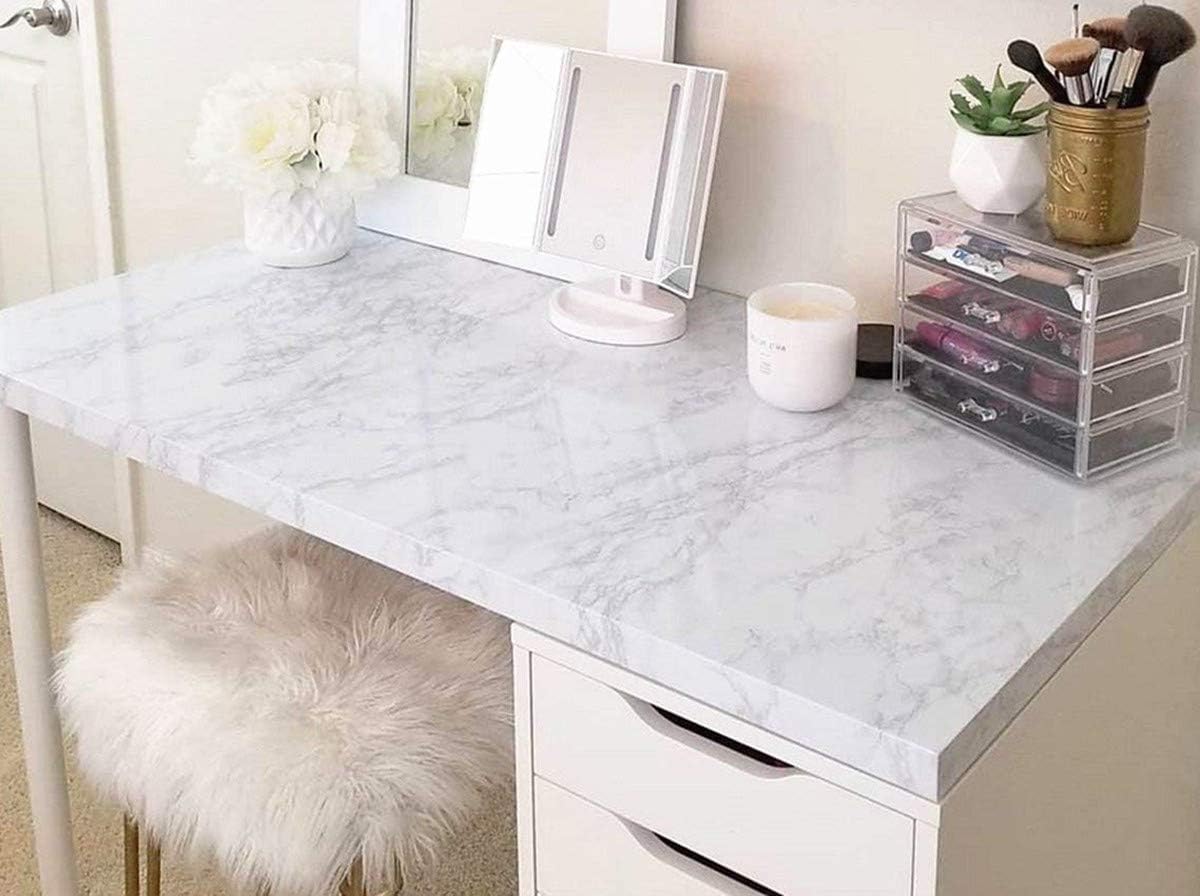
You’ve been staring at a greasy painted wall behind your stove, or a builder-grade bathroom surround that belongs in a 1994 motel, and you’ve decided peel-and-stick is your move. Good instinct — but “peel-and-stick” covers a surprisingly wide range of products, and the sticker price on the product listing is almost never the number that matters. Peel-and-stick wallcovering is a pressure-sensitive, repositionable panel you apply directly to a wall without paste or primer — peel off the backing, press it flat, and you’re done. The real cost question, especially in kitchens and baths where moisture, grease, and tile transitions complicate everything, is: what does this cost per square foot of finished, stay-up wall? That number — factoring in waste, overlap, pattern matching, and replacement probability — is what this guide will help you calculate before you pull the trigger.
| EDITOR'S PICK[Vamos Peel and Stick Backsplash…](https://www.amazon.com/dp/B0BJK95P3Z?tag=greenflower20-20) | Mid-tierMarble Peel and Stick Wallpaper… | Budget pickWENMER 17.71" x 118" Geometric… | |
|---|---|---|---|
| Pattern | Fish scale mosaic | Marble | Geometric hexagon |
| Dimensions per sheet | — | 17.7" x 78.7" | 17.7" x 118" |
| Removable | — | ✓ | ✓ |
| Price | $44.89 | $7.99 | $6.99 |
| See on Amazon → | See on Amazon → | See on Amazon → |
The Three Pattern Categories and What They Actually Cost at the Roll Level
Before you get to square-foot math, you need to know what you’re buying. Marble-look, geometric, and backsplash-style (also called tile-look or mosaic peel-and-stick) behave differently in terms of pattern repeat — the distance before a design element starts over — which directly controls how much material you waste.
Marble and stone looks are the most forgiving. Most marble-effect peel-and-stick panels use a free match or random match pattern: you don’t need to line up a specific motif across seams, so waste runs low, typically 5–10% overage is sufficient. Entry-level rolls (brands like RoomMates and Tempaper’s lower lines) run $12–$28 per roll at roughly 20.5 inches wide × 16.5 feet long, which works out to approximately 28 square feet per roll. Mid-tier options — Tempaper’s premium vinyl, Chasing Paper, and NuWallpaper — land at $30–$55 per roll for similar dimensions. At the premium end, Rebel Walls and Milton & King produce marble statement murals in non-woven peel-and-stick panels that start around $200 per panel covering roughly 10 square feet, pushing costs above $20/sq ft before waste.
Geometric patterns are the expensive category for waste. A bold hex grid or a diamond lattice often carries a half-drop match or straight match — meaning every other strip must shift down by half the repeat height so the geometry lines up across seams. On a 24-inch repeat, you can lose 12 inches off every other strip. On a small backsplash area (say, 15 sq ft), that waste can represent 25–35% of the material you purchase. House Beautiful’s 2025 roundup of peel-and-stick options notes that geometric patterns consistently generate the most reader complaints about unexpected material shortfall — almost always a matching-waste miscalculation, not a defective roll.
Backsplash-style (tile-look) panels occupy a separate product category that straddles wallcovering and peel-and-stick tile. These are thicker — often 1–3mm rigid or semi-rigid PVC panels — rather than thin film wallpaper. Brands like Smart Tiles, Aspect, and Art3d dominate this segment. Pricing runs $8–$18 per panel, with panels typically covering 0.9–3.0 square feet each. The thicker substrate handles steam and grease better than thin-film marble wallpaper, but the product is less forgiving to reposition once it makes contact with the wall.
By the Numbers: Typical Ranges as of Q2 2026
| Category | Price per Roll/Panel | Sq Ft per Unit | Raw $/Sq Ft | Typical Waste Add-On |
|---|---|---|---|---|
| Marble/stone (entry) | $14–$28 | 28 sq ft | $0.50–$1.00 | +8% |
| Marble/stone (mid) | $30–$55 | 28 sq ft | $1.07–$1.96 | +8% |
| Geometric (mid) | $32–$60 | 28 sq ft | $1.14–$2.14 | +25–35% |
| Backsplash tile-look | $8–$18/panel | 1–3 sq ft | $4.00–$8.00 | +10% |
The Real Cost-Per-Square-Foot Formula (And Where People Get It Wrong)
Here’s the calculation most buyers skip:
True $/sq ft = (Number of rolls needed × Price per roll) ÷ Net installed square footage
The trap is in “number of rolls needed.” Most product listings calculate rolls based on the room’s gross square footage divided by roll coverage. They don’t account for:
-
Pattern repeat waste — already discussed above, but worth quantifying. A geometric with a 24-inch straight match means you treat each strip as if it starts fresh at the top of the repeat. If your wall height is 9 feet (108 inches) and your repeat is 24 inches, each strip uses ⌈108 ÷ 24⌉ × 24 = 120 inches of material, not 108. That’s 11% waste per strip before you account for any cutting errors.
-
Seam overlap in high-humidity zones — In kitchens and baths, professional installers documented on Houzz forums consistently recommend a 1/8-inch overlap at seams rather than a true butt joint, because thin-film peel-and-stick shrinks slightly as humidity cycles. That overlap eats material and is rarely factored into roll calculators.
-
Tile transition and outlet cuts — Backsplash installs around an outlet can waste an entire panel if the cut lands in an awkward position. This Old House’s guide to peel-and-stick backsplash installation recommends buying a 15% overage buffer specifically for electrical and fixture cutouts.
-
Application failures and re-dos — Apartment Therapy’s aggregated reader reviews consistently flag that first-time installers waste 1–2 strips per wall on technique errors before they develop feel for tension and alignment. Budget for it.
Worked Example: A 20 Sq Ft Kitchen Backsplash in a Geometric Pattern
- Wall area: 20 sq ft
- Pattern: geometric with 18-inch straight match
- Roll size: 20.5 inches wide × 16.5 feet long (28 sq ft/roll), priced at $45
- Strip height needed: 18 inches (standard backsplash height)
- Repeat waste per strip: ⌈18 ÷ 18⌉ × 18 = 18 inches (clean, in this case — but a 20-inch strip height would waste 16 inches per strip)
- Outlet cutout waste buffer: 15%
- Installer error buffer (first-time): 10%
Adjusted sq ft to purchase: 20 × 1.25 (waste + buffers) = 25 sq ft
Rolls needed: 25 ÷ 28 = 0.89 → 1 roll (just barely)
True $/sq ft: $45 ÷ 20 = $2.25/sq ft installed
If your ceiling height were 9 feet instead of 18 inches, you’d be wrapping a full-height accent wall. The same geometric at 9-foot height with a 24-inch repeat pushes waste to ~18%, and you’d likely need 3 rolls for a 10-foot-wide wall — at $45/roll that’s $135 for roughly 90 sq ft of gross wall, or $1.50/sq ft — but your true coverage after waste is closer to 75 sq ft, making your real number $1.80/sq ft.
The point: per-square-foot cost is not stable. It moves with wall height, repeat size, and your experience level.
Kitchen vs. Bathroom: Where the Product Specs Actually Matter
Pattern and price aside, kitchens and bathrooms impose material requirements that cheaper thin-film options fail over time. Architectural Digest’s 2025 piece on peel-and-stick for wet areas notes that designers consistently distinguish between splashback zones (within 24 inches of a sink or cooktop) and accent wall zones farther back — and they spec products differently for each.
For splashback and behind-stove positions, the relevant spec is the adhesive’s heat and moisture resistance. Most entry-level peel-and-stick uses a water-based pressure-sensitive adhesive rated to roughly 120°F — fine for a bathroom wall but marginal directly behind a gas range. Backsplash tile-look panels from Art3d and Smart Tiles use a more aggressive acrylic adhesive system that owners on Houzz rate as significantly more durable in steam and grease environments. The tradeoff: they’re harder to remove cleanly, and claims about zero-damage removal are more contested for these products than for thin-film wallpaper in dry zones.
For bathroom accent walls away from the shower surround, thin-film marble and stone patterns perform well — owners in Apartment Therapy reader surveys report 2–4 years of clean adhesion on painted drywall without primer, provided the wall was cleaned with isopropyl alcohol before application. The standard installer caveat: flat or matte paint substrates hold better than eggshell or satin, because the smoother sheen gives the adhesive less mechanical grip. If your bathroom walls are satin-painted (common in builder-grade construction), budget for an adhesion-promoting primer or accept a shorter replacement cycle.
In-shower or wet-wall applications are where most peel-and-stick products simply don’t belong. No mainstream thin-film peel-and-stick wallcovering is rated for direct water contact or submersion. Tile-look panels marketed as “shower-safe” are the exception, but installer reviews aggregated on Houzz show that long-term seam integrity remains a concern, and grout-line caulking at panel edges is a required step that the product marketing often buries.
The Decision Framework: If X, Then Y
At this point you have enough to build a decision rule. Here’s how to structure it:
If your surface is a dry accent wall (bathroom vanity wall, kitchen feature wall away from the cooktop): Go mid-tier thin-film marble or stone look. Budget $1.50–$2.50/sq ft true installed cost. RoomMates’ higher-end lines and Tempaper Premium cover this range well based on published specs and consistent owner reviews. Add 10% overage and call it done.
If your surface is an active backsplash zone (behind the sink, adjacent to cooktop): Move to backsplash tile-look panels. Budget $5.00–$9.00/sq ft true installed cost once you account for cutout waste and the 15% buffer. The higher price buys you a product category that owners in long-run Houzz reviews consistently rate as more durable in moisture and grease.
If your pattern is geometric with a repeat over 18 inches: Add 25–30% to your roll count estimate before ordering, regardless of what the product listing’s calculator says. The math is unforgiving and the most common reason people need to re-order mid-project, often from a dye lot that no longer matches.
If you’re a first-time installer: Add one full roll to whatever your calculation produces. The technique gap between “looks easy on the video” and “actually hanging straight under tension on a slightly uneven wall” is real. Owners across aggregated reviews cite this as the single most common cause of material shortfall on first installs. That extra roll is cheap insurance.
If your budget is under $1.50/sq ft true installed: The honest answer is that kitchens and bathrooms are the wrong rooms for that budget tier. Entry-level thin-film products in wet adjacency zones generate the majority of the removability complaints documented in Apartment Therapy and Houzz review aggregations — either they fail early or they remove paint on the way out. Either outcome costs more than the savings.
The cost-per-square-foot number is just arithmetic. The decision is knowing which number you’re actually solving for.