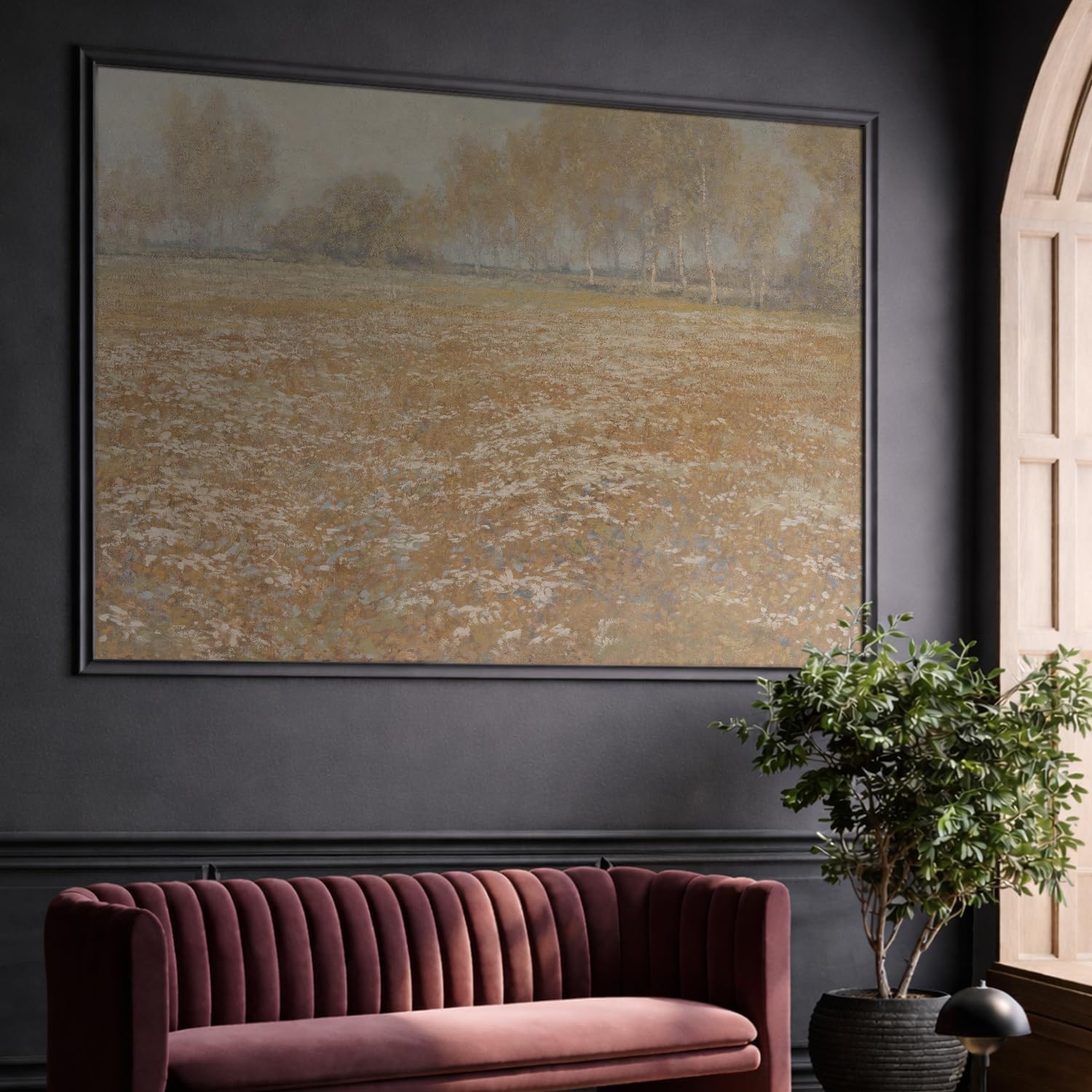
Imagine you’ve just found the mural — a moody, oversized botanical print that would cover the entire wall behind your bed or that awkward expanse of drywall in a hotel corridor you’re speccing out. You screenshot it, send it to the brand, and get back a quote for twelve panels. Twelve. You weren’t expecting that. What does “panel” even mean here? Is that the same as a roll? Are you ordering the right number? And what happens if the pattern doesn’t line up across panels when your installer shows up?
Large-format wall murals are different from standard wallpaper rolls in one fundamental way: they’re printed as a single continuous image that gets sliced into vertical strips (called panels) for shipping and installation. The whole wall is one picture, not a repeating tile. That sounds simpler, but it introduces a specific set of math problems — and substrate choices — that catch a lot of buyers off guard on their first mural project. This guide walks through the panel calculation logic, explains how pattern waste is different for murals versus repeating wallpaper, and gives you a clear decision framework for choosing between the three substrate types you’ll actually encounter in the market.
How Mural Panels Actually Work (and Why the Math Matters)
A mural panel is not a roll. A standard wallpaper roll contains several feet of a repeating pattern; you cut lengths from it and paste them side by side. A mural panel is one numbered vertical strip of a larger image — strip 1, strip 2, strip 3 — and they must be hung in sequence to reconstruct the full picture. Most residential mural brands (Rebel Walls, Photowall, and Feathr are representative examples) size their default panels at approximately 50 cm (about 20 inches) wide, though some commercial suppliers default to wider panels at 52 or 60 cm. The image’s total width divided by the panel width gives you the panel count, before any adjustments.
Here’s where buyers get tripped up: the mural is printed to a specific dimension, not to your wall’s dimension. You order the closest available size that covers your wall with at least a few centimeters of overhang on each edge — that overhang gets trimmed after installation. If your wall is 148 inches wide and the mural comes in 140-inch and 160-inch widths, you order the 160-inch version. The extra 12 inches of image gets trimmed off. You’re paying for pixels you’ll never see, and that’s correct — it’s not waste, it’s insurance against installation variance.
Height works the same way. Most brands let you specify a custom height or choose from preset increments (240 cm, 270 cm, 300 cm are typical). Order slightly taller than your ceiling-to-baseboard measurement. Installers at This Old House note that a 5–10 cm overhang top and bottom is standard practice, giving you room to plumb the first panel and trim cleanly to the ceiling line and floor.
The panel count formula, plain:
Wall width (in cm) ÷ Panel width (in cm) = Number of panels, rounded up to the next whole number
If your wall is 380 cm wide and panels are 50 cm, you need 8 panels (380 ÷ 50 = 7.6, round up). Order 8.
Pattern-Match Waste: Why Murals Are Cheaper to Install Than Repeating Wallpaper
This is the part where murals actually win against repeating-pattern wallpaper for large accent walls — and understanding why will sharpen your client conversations.
With traditional repeating wallpaper, every strip you cut has to be aligned to the previous strip’s pattern. The distance between one point in the pattern and the next identical point is called the pattern repeat. A wallpaper with a 25-inch straight repeat means that on average you’ll waste roughly half a repeat per strip just to keep the pattern matched — that can add 15–30% to the total square footage you need to order. A drop match (where the pattern on the left strip is offset from the pattern on the right by half the repeat distance) is even more expensive in waste terms, sometimes pushing total overage requirements to 35%.
Murals don’t have a repeat in that sense. Each panel is pre-numbered and pre-printed to align with the next one at a specific seam line. There’s no hunting for a match — you just butt the panels together in order. The waste you’re paying for is strictly dimensional (the overhang trim described above), not pattern-driven. For a standard 380 cm × 270 cm wall, dimensional overage typically adds roughly 5–8% to the effective cost, versus 15–35% for a drop-match repeating wallpaper covering the same area.
By the numbers — typical waste comparison:
| Wallpaper type | Pattern repeat | Typical waste overage |
|---|---|---|
| Mural (numbered panels) | None | 5–8% (dimensional trim only) |
| Straight-match repeating | 18–25 in | 15–20% |
| Drop-match repeating | 18–25 in | 25–35% |
| Random/texture | None | 10% standard |
Sources: waste percentage ranges are consistent with guidance published by the Wallcovering Association in their performance and installation standards documentation, and with installer practice notes aggregated by This Old House.
One real caveat: seam visibility. Because mural panels must be butted together (not overlapped), any inconsistency in hanging plumb or wall flatness becomes visible as a light gap or shadow at the seam. This is the tradeoff. The pattern-match savings are real; the seam precision requirement is also real. On smooth drywall under even lighting, a skilled installer can achieve nearly invisible seams. On textured plaster or under raking light (windows at a sharp angle to the wall), seams will show more. If your project has difficult lighting conditions, factor in a professional install rather than DIY — the cost of a botched seam on a $400-per-panel mural is not abstract.
Substrate Decision: Non-Woven, PVC, or Fabric-Backed?
This is the part of the buying decision that most online mural guides gloss over, and it’s where intermediate practitioners leave money and performance on the table. The substrate — what the printed surface is made of and what backs it — determines how the mural installs, how it holds up, and whether it can come down without damaging the wall.
Non-woven (the default for most residential murals)
Non-woven substrate is a blend of polyester and cellulose fibers bonded together without weaving. It’s dimensionally stable — meaning it doesn’t stretch or shrink significantly when it gets wet with paste — which is the main reason most residential mural brands default to it. You paste the wall (not the paper), hang the panel, and adjust its position for 5–10 minutes before it starts to grip. Homeowners report that non-woven murals from brands like Rebel Walls and Photowall come down cleanly in most cases, though Apartment Therapy notes that results on older drywall or paint that hasn’t fully cured vary considerably. For a first-time installer, non-woven is the most forgiving substrate in the residential tier.
Non-woven spec sheets typically show a weight in the 130–180 g/m² range for residential grades. Heavier weights telegraph fewer wall imperfections and hold printed colors more densely — relevant if your mural has deep blacks or highly saturated colors.
PVC / vinyl (Type II and Type III for commercial applications)
When a project crosses from residential accent wall to commercial installation — hotel corridors, restaurant feature walls, healthcare waiting rooms — the relevant substrate shifts to vinyl-backed wallcovering. The Wallcovering Association’s classification system rates Type II vinyl (at roughly 13 oz. total weight) for most commercial applications, and Type III (20 oz.) for high-traffic or abuse-prone surfaces. Brands like Koroseal, MDC Wallcoverings, and Innovations in Wallcoverings produce large-format custom prints on these substrates for exactly these use cases.
The tradeoffs versus non-woven: PVC vinyl is heavier, less breathable (moisture trapped behind it can eventually cause mold on porous substrates), and requires stronger adhesive. It is, however, dramatically more resistant to scuffing, cleaning with commercial disinfectants, and the general abuse that a hotel corridor wall takes. If your spec requires a surface that can be wiped with quaternary ammonium disinfectants — common in hospitality and healthcare — non-woven is not your substrate, Type II vinyl is.
Removal is the other big flag. Type II and III vinyl murals are not designed for clean removal the way residential non-woven is. Architectural Digest coverage of commercial renovations consistently shows vinyl wallcovering removal budgeted as a line-item demolition cost, not a DIY weekend project. Price that in before you spec it for a space that might change concepts in three years.
Fabric-backed vinyl and woven-texture substrates
A third tier exists for high-end residential and luxury hospitality: fabric-backed vinyl and woven-textile substrates (sometimes called Type IV in commercial classification). These are printed on materials that have a woven textile as the face or backer, giving the mural dimensional texture that catches light differently from flat-printed surfaces. Feathr and some bespoke commercial suppliers offer this. The premium is real — fabric-backed substrate murals often run 20–40% more than equivalent non-woven prints. For a residential bedroom accent wall, the tactile payoff is largely a luxury. For a luxury hotel lobby installation where guests will be standing close to the surface under accent lighting, the texture justification is easier to make.
Decision Framework: If X, Then Y
If you’ve read this far, you’re probably holding a quote, a floor plan, or a client brief. Here’s how to map your situation to the right choice:
If the space is residential with a painted drywall surface and you want a clean exit: Non-woven substrate, paste-the-wall installation, order panels to cover with 5–8 cm overhang on each edge. Confirm the wall paint has cured at least 30 days before install.
If the space is commercial and will see regular cleaning or physical contact: Specify Type II vinyl minimum. Budget adhesive and professional installation. Budget removal as a future line item. Require the brand to provide a full spec sheet with weight, washability rating, and any fire/smoke certifications required by your jurisdiction.
If the space has challenging lighting (raking natural light, wall-washers at shallow angles): Seams will be visible regardless of substrate. Either choose a mural image with vertical compositional elements that disguise seam lines (tree trunks, architectural columns, vertical botanical stems), or budget for a professional installer with mural-specific experience. House Beautiful’s coverage of designer mural installations regularly credits professional hanging as the variable that separates a transformation from a disappointing result.
If your client wants the option to change the mural in 2–3 years: Peel-and-stick non-woven substrate (offered by brands like Tempaper and RoomMates at the accessible end, and by Rebel Walls and Photowall at the premium end) gives you the lowest-risk exit. Published removability claims are stronger for peel-and-stick than paste-the-wall on new paint, though aggregated owner reviews consistently flag that success depends heavily on the paint type and age of the underlying surface — matte paint is riskier than eggshell or satin.
The math for a mural project is never complicated once you understand what you’re calculating: panels are strips of a single image, not rolls of a repeat; waste is dimensional not pattern-driven; and substrate choice is a function of use intensity, not just aesthetics. Get those three variables right before you finalize a quote, and you’ve eliminated the most common and most expensive mistakes on large-format mural installs.