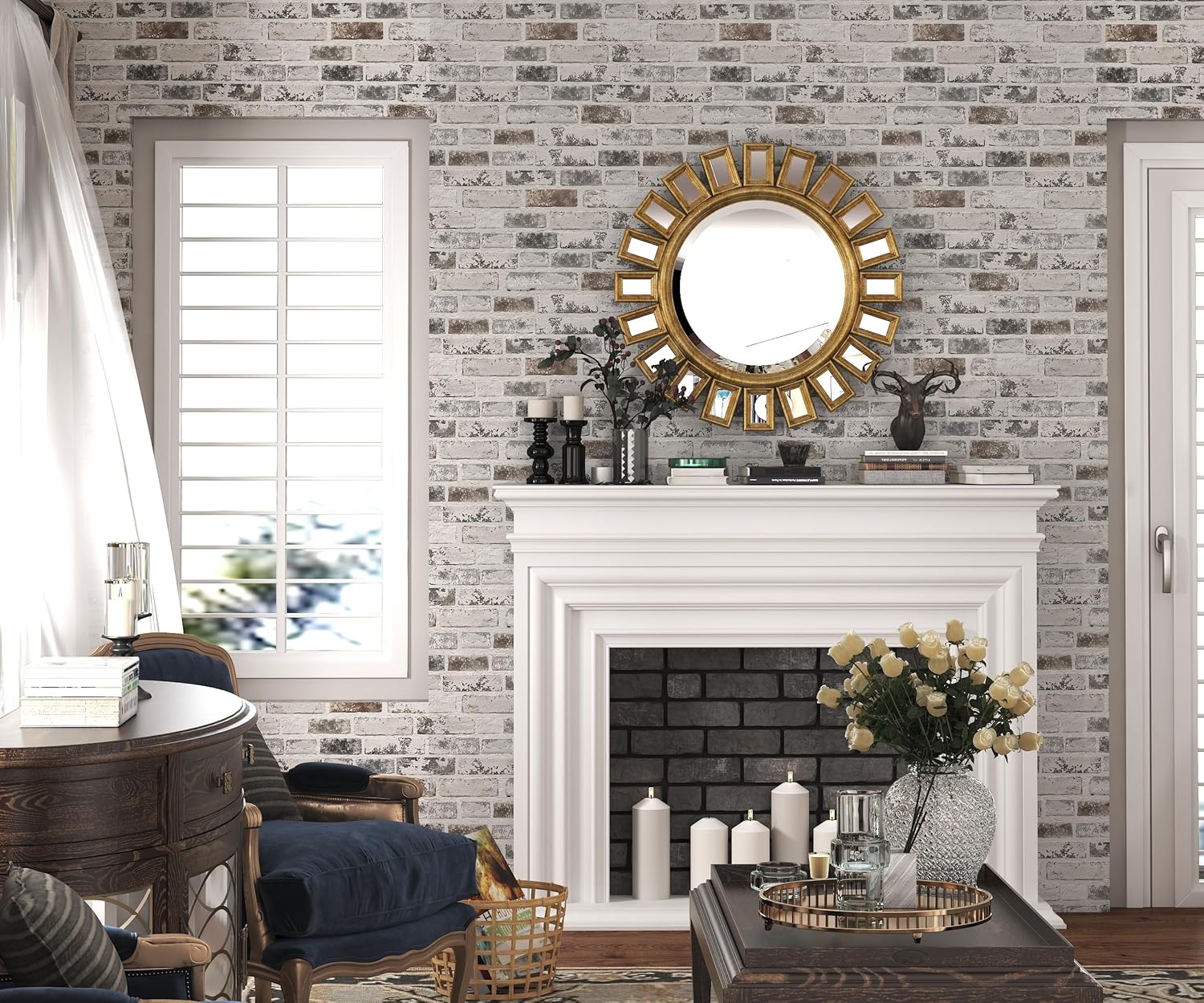
You’re standing in front of a blank dining room wall, phone in hand, looking at a faux-brick peel-and-stick panel that costs $28 and ships in two days. It promises the warm, industrial texture of exposed brick — no mortar, no contractor, no lease violation. But somewhere between the product listing and checkout, a reasonable question surfaces: is the “texture” actually a surface embossment you can feel, or just a photograph of brick printed on flat vinyl? And will four rolls be enough, or will you run short by the last corner? These are the questions that determine whether a $150 accent wall becomes a $300 frustration. This guide is here to give you a decision framework — not a sales pitch. We’ll cover how texture depth actually works in this category, how to run the roll math correctly the first time, and what total wall cost looks like at three different budget tiers.
Texture Depth: What the Spec Sheet Won’t Tell You (and What to Ask Instead)
“Texture” in peel-and-stick wallcovering is not a single thing. It exists on a spectrum, and where a product falls on that spectrum has a bigger effect on perceived realism than pattern design does.
Printed texture only. This is a flat vinyl or non-woven substrate — meaning the base material has no physical depth — with a high-resolution photographic print of brick, concrete, or stone. The pattern can be extraordinarily convincing in photographs and at a distance of six feet or more. Apartment Therapy’s roundup of peel-and-stick options consistently notes that flat-printed faux finishes “photograph beautifully but feel unmistakably smooth to the touch.” At close range or under raking light (light hitting the wall at a shallow angle, which reveals surface topography), the illusion collapses. For most renters doing a bedroom feature wall viewed from across the room, this is a perfectly viable choice. For a dining room or entryway where guests approach and may touch the surface, it typically undersells.
Embossed texture. Here the substrate itself is physically molded during manufacturing so that grout lines are slightly recessed and brick or block faces are microscopically raised. Emboss depth in consumer-grade peel-and-stick products — the kind sold at mass-market home improvement retailers and through specialty wallcovering sites in the $18–$55 per roll range — typically runs between 0.3mm and 0.8mm. That’s a modest but real tactile difference. Under raking light, embossed surfaces cast genuine shadow lines that reinforce the pattern. Architectural Digest’s coverage of textured wallcoverings notes that emboss depth in this range is “enough to read as dimensional under most residential lighting conditions.” Check product spec sheets for the term “embossed” plus, ideally, a stated depth in millimeters. If neither appears, the product is most likely printed-only.
3D panel systems. These are a separate category entirely — rigid or semi-rigid PVC (polyvinyl chloride, the same plastic family as most vinyl wallcovering) panels, sometimes sold alongside peel-and-stick wallpaper but functionally different. Panel thickness typically runs 3mm to 6mm. They are genuinely three-dimensional and look convincingly architectural even under harsh sidelighting. The tradeoffs: corners and edge transitions require cutting with a utility knife or circular saw, grout-line alignment between panels demands precision, and installation on a textured wall (common in rentals) is notoriously difficult because adhesive panels need flat contact to bond reliably. This Old House’s installation guidance specifically flags “textured or orange-peel walls” as a surface requiring skim-coating or a skim-primer before panel installation.
Decision rule: If you want real tactile depth and your wall is already smooth, a 3D panel system is the most credible faux result. If your wall has any texture, or if you are a renter who needs full removability, a quality embossed peel-and-stick roll (look for stated emboss depth on the spec sheet) is the correct middle path. Flat-printed is appropriate for photography-oriented spaces or very constrained budgets.
Roll Math: The Single Calculation Most DIYers Get Wrong
The standard mistake is dividing wall square footage by roll coverage and ordering that number of rolls. This ignores two variables that reliably cause shortfalls: pattern repeat and waste from cutting.
Pattern repeat is how far down the wall a pattern must travel before it begins again — the vertical distance after which the design duplicates. A brick pattern might have an 18-inch repeat (meaning every 18 inches the brick rows reset to the same position). When you cut strips from a roll, every strip after the first must be started at a point in the roll where the pattern aligns with the bottom of the previously hung strip. Depending on where the previous strip ended in the repeat cycle, you may discard up to one full repeat length of material per strip. For a wall with many narrow strips — around windows or doors — this waste compounds quickly.
A common formula used by professional installers: calculate usable strip yield per roll by dividing roll length by (strip height + one full repeat). Then divide total strip count needed into rolls required, rounding up.
By the numbers — sample 8 × 10 ft accent wall (80 sq ft):
| Variable | Value |
|---|---|
| Wall width | 10 ft → 5 strips at 20 in wide |
| Roll dimensions (typical) | 20.5 in × 16.4 ft |
| Repeat length | 18 in |
| Usable strips per roll | 16.4 ft ÷ (8 ft + 1.5 ft) = 1.7 → 1 full strip |
| Rolls needed | 5 strips → 5 rolls minimum |
| ”Square footage” method estimate | 80 sq ft ÷ 28 sq ft per roll = 2.9 → 3 rolls |
The square-footage shortcut suggests 3 rolls. The repeat-adjusted calculation shows you actually need 5. Order the repeat-adjusted number, plus one additional roll as a buffer for miscuts and future repairs. House Beautiful’s coverage of faux-finish wallcovering installations specifically calls out “the repeat trap” as the most common reason DIY projects run short mid-wall.
A note on non-woven substrates versus PVC for faux textures: most embossed brick and concrete peel-and-stick products are PVC-backed, not non-woven (which is a fabric-like base material, more common in traditional paste wallpapers). PVC-backed panels are dimensionally stable — they don’t stretch or shrink with humidity — which is an advantage for pattern alignment. Non-woven products are easier to reposition after application but are less common in heavily textured faux-finish formats because the emboss tooling is harder to apply to that substrate.
Total Wall Cost: Three Tiers, Honest Numbers
“How much will this actually cost?” is the question the product listing won’t answer directly. Here’s what the full project looks like at three realistic budget tiers for a single standard accent wall (approximately 80 square feet, 8-foot ceiling height).
Entry tier ($80–$160 total) This is flat-printed or lightly embossed peel-and-stick from mass-market sources, priced roughly $12–$25 per roll. After repeat-adjusted math — typically 5–6 rolls for our sample wall — materials run $60–$150. Add a smoothing tool (a plastic squeegee-like applicator, often called a wallpaper smoother), a sharp utility knife and replacement blades, and a level: roughly $20–$30 in tools if you don’t own them. Removal later is generally clean on smooth, primed drywall, but the Wallcovering Association’s performance ratings guidance notes that adhesion performance on unprimed or flat-paint drywall is “variable and surface-dependent” — meaning test a sample strip before committing to the full wall.
Mid tier ($200–$350 total) Embossed peel-and-stick with stated texture depth from specialty brands in the $35–$55 per roll range. At 5–6 rolls, materials land at $175–$330. These products typically carry manufacturer-stated removability claims (look for “repositionable” and “damage-free removal” language on the spec sheet, not just in marketing copy). Owners across aggregated reviews on platforms like Houzz and home improvement retailer review sections consistently report cleaner removal on this tier compared to entry-level PVC products. Per Architectural Digest’s buyer guidance on peel-and-stick, mid-tier products also tend to have more consistent emboss registration — meaning the printed grout lines and the physically recessed grout lines actually align, which cheaper products sometimes fail to achieve.
Premium/3D panel tier ($350–$700+ total) Rigid or semi-rigid 3D PVC panel systems priced $4–$12 per square foot. On an 80 sq ft wall, materials alone run $320–$960 depending on the product line and retailer. Add adhesive caulk or panel adhesive ($15–$30), a miter box or circular saw for corner cuts, and potentially a skim-coat application if your wall isn’t flat ($50–$150 as a DIY product cost, more if you hire a finisher). The visual payoff — genuine architectural dimensionality that holds up under direct sidelighting — is substantial. The removal story is not. Most 3D panel systems are considered semi-permanent installs. House Beautiful notes that panel removal “typically requires patching and repainting the underlying drywall,” making this tier genuinely unsuitable for renters and renovation-minded homeowners who plan to change directions in under five years.
Making the Call: If X, Then Y
If you’re a renter on a budget who wants social-media-ready results: Go mid-tier embossed peel-and-stick. Spend the extra $10–$15 per roll to get a product with a spec-sheet emboss depth and a documented removability claim. Don’t buy on square footage alone — run the repeat math or you will run short.
If you own the space, your wall is smooth, and you want the most convincing faux result: The 3D panel system wins on realism. Budget for skim-coating if needed. Factor in that this is a 5+ year commitment and price accordingly.
If you are a design professional or hospitality specifier evaluating these materials for a commercial accent wall: neither consumer peel-and-stick tier is rated to commercial durability standards. The Wallcovering Association’s Type II and Type III classifications — which cover abrasion resistance, tear strength, and washability benchmarks — apply to commercial vinyl, not to consumer peel-and-stick products. For commercial applications, specify Type II architectural vinyl with a faux-texture print from commercial-grade suppliers. Consumer embossed peel-and-stick is a residential tool; using it in a hotel corridor or restaurant is a maintenance liability within 18 months, regardless of how it looks at install.
One last number worth keeping front of mind: the average peel-and-stick faux-brick or concrete product carries a manufacturer-stated coverage of 20–30 square feet per roll. The average real accent wall is 60–100 square feet. The gap between those numbers — and the repeat waste on top of it — is where almost every budget shortfall originates. Do the math before you order, order a buffer roll, and you’ll finish the wall with material to spare rather than a frantic reorder that arrives in a slightly different dye lot.